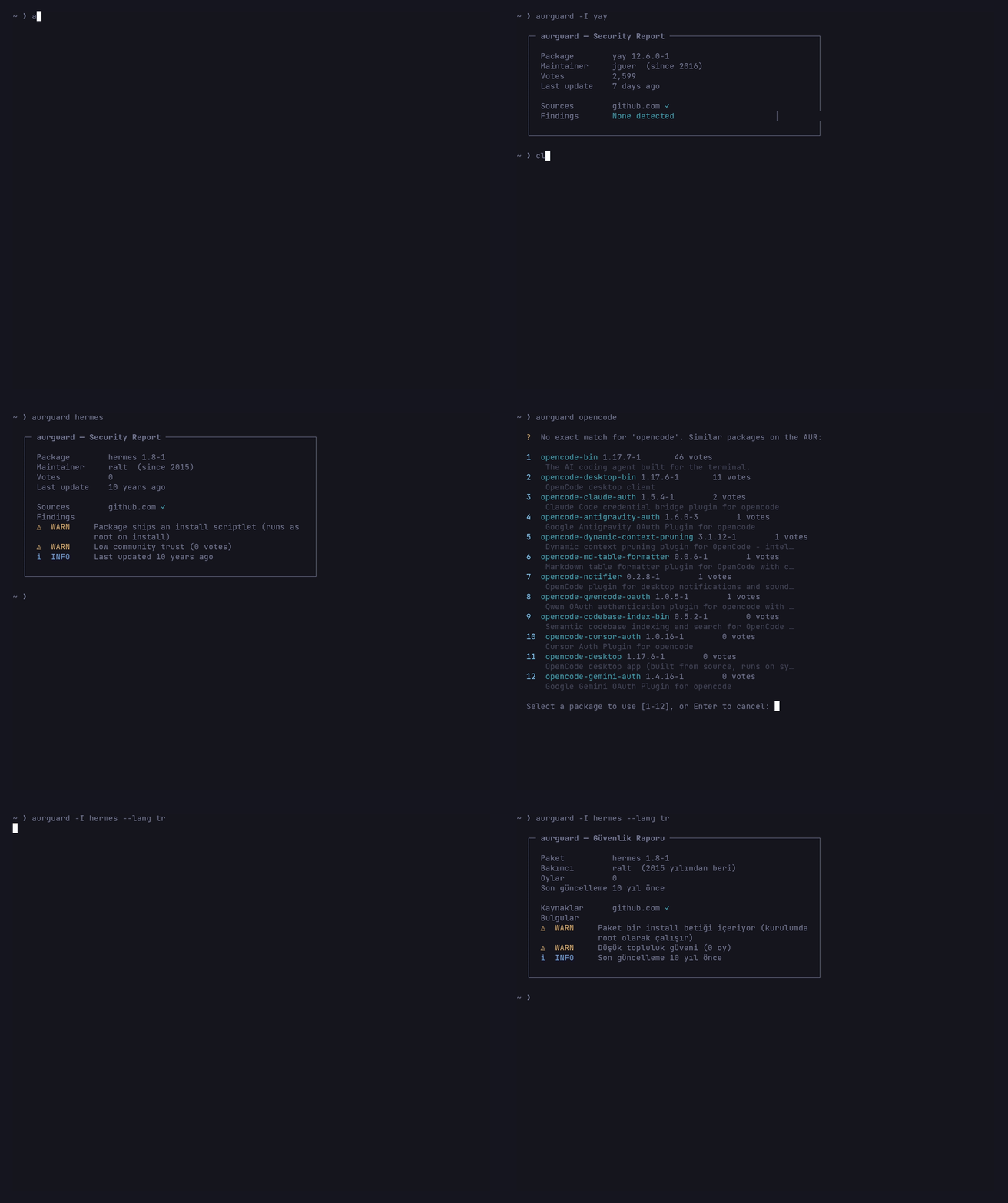
# Why
AUR helpers happily run untrusted build code as your user — and
.install scriptlets as root. A typo-squatted package, a
hijacked maintainer account, or a single curl … | sh line is all
it takes. aurguard puts a review step in front of that.
Clone-first, TOCTOU-safe
The repo is cloned once, then the same tree is analyzed and built — no swap between what you read and what runs.
Real bash parsing
A tree-sitter-bash AST sees eval and
pipe-into-shell through quoting tricks, comments, and here-docs.
Never executes
Analysis is purely static. A clean report means “no known-bad shapes,” and nothing in the package has run.
# Why isn't aurguard published on the AUR itself?
Short answer: timing. In June 2026, the AUR suffered a large-scale
supply-chain attack — 400+ community packages were hijacked and
turned into a malware delivery network (credential-stealing
payloads, in some cases rootkit-like persistence) — and Arch
temporarily locked down new AUR account registration while
cleaning it up. Publishing a security tool into that
repository in the middle of that incident isn't something we're
comfortable doing until the AUR's own incident response has fully
run its course. Build-from-source (install.sh),
cargo install aurguard, and
npm install -g aurguard all work today regardless —
see Install.
Arch Linux's own incident notice (published 2026-06-12), quoted in full:
We are currently experiencing a high volume of malicious package adoption and updates in the Arch User Repository. We are actively working to track existing malicious commits and to prevent additional malicious commits from being pushed. While this is happening, and while we work to build a more permanent solution, users may experience issues with: creating new accounts on the AUR, forcing package updates, and adoption or creation of new packages. We continue to encourage all users of AUR packages to review the entire PKGBUILD and to inspect install scripts, especially while updating during this period. If you notice suspicious commits on a package you use, please reach out to Arch staff via the aur-general mailing list with further information.
For the current status and any follow-up notices, see the AUR itself: aur.archlinux.org.
Türkçe
Kısa cevap: zamanlama. Haziran 2026'da AUR, büyük çaplı bir
tedarik zinciri saldırısına uğradı — 400'den fazla topluluk
paketi ele geçirilip bir kötü amaçlı yazılım dağıtım ağına
dönüştürüldü (bazı durumlarda kimlik bilgisi çalan yükler,
rootkit benzeri kalıcılık mekanizmaları dahil) — ve Arch bu
temizlik sürerken AUR'a yeni hesap kaydını geçici olarak
durdurdu. Bu olay tam ortasındayken bir güvenlik aracını
aynı depoya yayınlamak, AUR'un kendi olay müdahalesi tamamen
sonuçlanana kadar rahat hissettiğimiz bir şey değil. Kaynaktan
kurulum (install.sh), cargo install aurguard
ve npm install -g aurguard bugün hiçbir kısıtlama
olmadan çalışıyor — bkz. Install.
Şu anda Arch User Repository'de yüksek miktarda kötü amaçlı paket benimseme ve güncellemesi yaşıyoruz. Mevcut kötü niyetli commit'leri takip etmek ve ek kötü niyetli commit'lerin gönderilmesini önlemek için aktif olarak çalışıyoruz. Bu yaşanırken ve daha kalıcı bir çözüm oluşturmaya çalışırken, kullanıcılar şu konularda sorun yaşayabilir: AUR'da yeni hesap oluşturma, paket güncellemelerini zorlama, yeni paketlerin sahiplenilmesi veya oluşturulması. AUR paketi kullanan herkesi, özellikle bu dönemde güncelleme yaparken tüm PKGBUILD'ı incelemeye ve kurulum betiklerini gözden geçirmeye teşvik etmeye devam ediyoruz. Kullandığınız bir pakette şüpheli commit'ler fark ederseniz, lütfen daha fazla bilgiyle aur-general posta listesi üzerinden Arch ekibine ulaşın.
Güncel durum ve olası takip bildirimleri için AUR'un kendisine bakın: aur.archlinux.org.
# What it checks
Twelve analysis passes feed one report: a tree-sitter-bash AST pass, textual
heuristics, a 24-rule YARA-style signature database (plus an updatable
rules.d/ overlay), recursive decoding, anti-evasion normalization,
dataflow taint, IOC/wallet matching, committed-binary + VirusTotal checks, a
source-tree text scan over every build-helper script, PGP/pkgver()
integrity, and package metadata & history.
24 YARA-style signatures
A dependency-free rule engine matches named malware shapes — miners,
exfiltration, persistence, defense-evasion, container escape, cloud-metadata
SSRF, reverse shells — with vetoes that stay quiet on legitimate
$pkgdir packaging. Extend it with your own rules in config.
Anti-evasion decoding
Recursively decodes nested base64/hex, folds b""ash /
${IFS} / $'\x65' tricks, reverses rot13 /
reversed / URL-encoded strings, and flags base64-wrapped gzip/ELF
payloads — then re-runs every signature over what it finds.
Dataflow taint
Connects untrusted input to execution across lines: a captured
$(curl …) or a downloaded file reaching
eval, sh -c, a here-string, or
source — the split-fetch-then-run trick that single-line
rules miss.
Committed binaries & VirusTotal
Prebuilt executables checked into a package tree are flagged and
SHA-256-hashed. Check them on VirusTotal — offline by hash + link, or
via the API with --vt. Nothing is ever uploaded.
Source & metadata
Insecure/IP/shortened source URLs, SKIP checksums, untrusted
git clone, maintainer age, low votes, staleness, and
pkgrel churn.
Root scriptlets
.install hooks run as root, so they get the full rule set
plus a flag for any network access at install time.
Source-tree text scan
Malware doesn't have to live in the PKGBUILD. Every
*.sh, *.py, *.js, Makefile,
build.rs, and unreferenced .install file in the
cloned tree gets the same AST + signature + decode + taint treatment,
attributed by path:line.
Updatable ruleset
aurguard --update-rules fetches a versioned TOML signature
set over HTTPS, validates it before touching disk, and never downgrades.
Layer your own rules in rules.d/ without recompiling.
Approval ledger
Approve a PKGBUILD once; aurguard surfaces silent upstream edits on the next install via a content digest.
Scriptable
--json output and exit codes
(0/10/20) make it a clean CI gate.
Five languages
Interface and findings localized end to end.
# A sample of the rules
Findings are bucketed INFO · WARN · CRITICAL; a package's risk is the highest severity it trips. CRITICAL is blocked by default.
…and more — 24 signature rules plus the heuristic, decode, taint, metadata,
and integrity passes. Add your own rules and IOC lists in
config.toml.
# Install
Linux only — the AUR is Arch-specific.
From source (recommended)
# needs the Rust toolchain + a C compiler (tree-sitter-bash grammar)
git clone https://github.com/lunanoir21/aurguard-project.git
cd aurguard-project
cargo build --release
./target/release/aurguard --setup
From npm
npm install -g aurguard
The npm package is a thin launcher with no install script. The prebuilt
binary ships as a platform-specific optional dependency, so nothing is
downloaded or executed at install time — no postinstall, no
remote-code surface, zero runtime dependencies.
From crates.io
cargo install aurguard